
Quick reminder:
Cognitive Design Lab, the practical companion to this newsletter, is a free workshop offered every other Friday at 1 PM ET. Next session: January 9, 2026.
On Cognitive Design

The Hierarchy of Organizational Values
A Universal Logic for Innovation
The True Nature of Values
Values are the most misunderstood concept in business.
Organizations list them in vision statements, hang them on walls, include them in onboarding materials — but rarely structure them into intelligence. This disconnect creates a gap between what businesses say they value and how they actually operate.
The truth is more powerful: Values drive human decision-making, providing a universal logic for growth and innovation.
Every choice a person makes — from products they purchase to brands they trust to leaders they follow — is fundamentally a function of their values. When a customer chooses one product over another, when an employee commits to one company over another, when a market shifts in a new direction — values are the underlying driver.
Values function as a decision-making filter:
- Priority Values determine what matters most in a given context
- Trade-Off Values establish what people are willing to sacrifice
- Deal-Breaking Values define non-negotiable conditions
When customers decide between competing products, they're navigating a complex values hierarchy. Speed, convenience, trust, security, connection, status, simplicity — these values govern decisions more powerfully than features, pricing, or even needs.
Why Values Are Better Design Tools Than Needs

Maslow's Hierarchy of Needs redefined how we think about human motivation. Design Thinking adopted it wholesale — empathize with user needs, then solve for what remains unmet. Human-Centered Design built the internet, created the smartphone revolution, and established experience design as an essential business discipline.
But needs and values go hand in hand. Every human need has a corresponding business value that fulfills it:
- Physiological needs → Sustainability values
- Safety needs → Security values
- Love & Belonging needs → Connection values
- Esteem needs → Empowerment values
- Cognitive needs → Understanding & Information values
- Aesthetic needs → Inspiration values
- Self-Actualization needs → Fulfillment values
- Transcendence needs → Transcendence values
This is the fundamental axiom of commercial exchange: In the marketplace, human needs are fulfilled by business values.
The problem isn't needs versus values. The problem is what happens when you optimize for triggering the need without actually fulfilling the value.
The Fogg Model reduces human decision-making to a formula: Behavior = Motivation × Ability × Prompt. The Hook Model systematizes addiction through trigger-action-reward cycles. Behavioral designers hijacked human-centered frameworks to feed us a never-ending stream of stuff we like, turning us into scrolling addicts.
A platform designed around the NEED for belonging maximizes engagement metrics. A platform designed around the VALUE of connection optimizes for quality of experience. Semantics matter.
Machine efficiency must serve human values — asking what fulfills the value, not what triggers the need. Needs can be triggered, manufactured, manipulated. The attention economy runs on it.
Values are different. You can't manufacture someone's values. You can appeal to them, align with them, even help articulate them — but you can't create them from nothing. Values emerge from identity, not circumstance. They resist manipulation precisely because they're intrinsic — and because they self-validate through real outcomes, not engagement metrics.
Here's why values are better design tools than needs:
- Values are measurable. Trust, simplicity, and delight can be quantified. Customer obsession validates itself through return rates and advocacy.
- Values are consistent. Needs constantly change based on circumstance. Values remain stable across contexts, providing reliable decision criteria.
- Values create moats. Competitors can match your features, undercut your price, or outspend your marketing. They cannot authentically share your values without becoming you.
- Values compound. They strengthen over time through consistent expression, building trust that accelerates every time you interact.
When every company has the same AI tools, the differentiator isn't what machines can do — it's what humans value.
From Values to Value Systems

Here's where most organizations stop. They identify values but fail to operationalize them.
Individual values remain aspirational concepts that require interpretation. "We value innovation" sits on a wall while nothing ships. "Customer first" gets repeated in meetings while customers leave.
Value Systems are different. They include implementation logic, measurement frameworks, and decision criteria. Each operates as a complete unit, containing:
- Discovery Frameworks: Structured pursuit of unique logic and values
- Implementation Capabilities: Clear criteria for translating values into impacts
- Measurement Protocols: Specific methods for tracking fulfillment and alignment
- Decision Parameters: Machine-executable guidelines for self-governance
The critical insight: Value Systems self-validate. They prove themselves through operation, not committees.
A customer-obsessed company validates itself through customer behavior — they return, spend more, tell others. No surveys needed. That's a Value System.
Apple's simplicity isn't just a value statement. It's coded into every product, interface, and decision. When complexity creeps in, it fails the system test. The value validates itself through observable execution.
This matters for AI because machines can't judge "innovation" as an abstract concept. But they can observe whether features shipped and users adopted them. Self-validation transforms intentions into executable logic.
The Shared Value: Where Exchange Happens
Human-Centered Design investigates needs and assumes values will follow. Value-Centric Design investigates values and assumes needs are already understood.
Both frameworks operate from the same axiom: In the marketplace, human needs are fulfilled by business values. The question is which side you investigate.
VCD is anchored by the Shared Value, which is a value fulfilled in an exchange:
- Trust in transactions (Venmo)
- Precision in manufacturing (BMW)
- Simplicity in design (Apple)
- Reliability in logistics (FedEx)
- Discovery in search (Google)
When customers choose you, they're not just buying a product. They're buying into a value that both of you share, and you fulfill.
Patagonia customers don't just buy jackets — they share the value of environmental responsibility. Google customers don't just search for knowledge — they embrace universal access to it.
This shared value is where intrinsic desirability meets fair return. It's the fulcrum where what you believe becomes what the market rewards. They believe you.
You've created brand equity.
That exchange is what separates a value from a value system, giving innovation a machine-executable logic: Hone intrinsic desirability to unlock fair return.
Brand equity emerges from shared values. But which values? In what order? The Hierarchy of Organizational Values provides the map.
The Hierarchy of Organizational Values
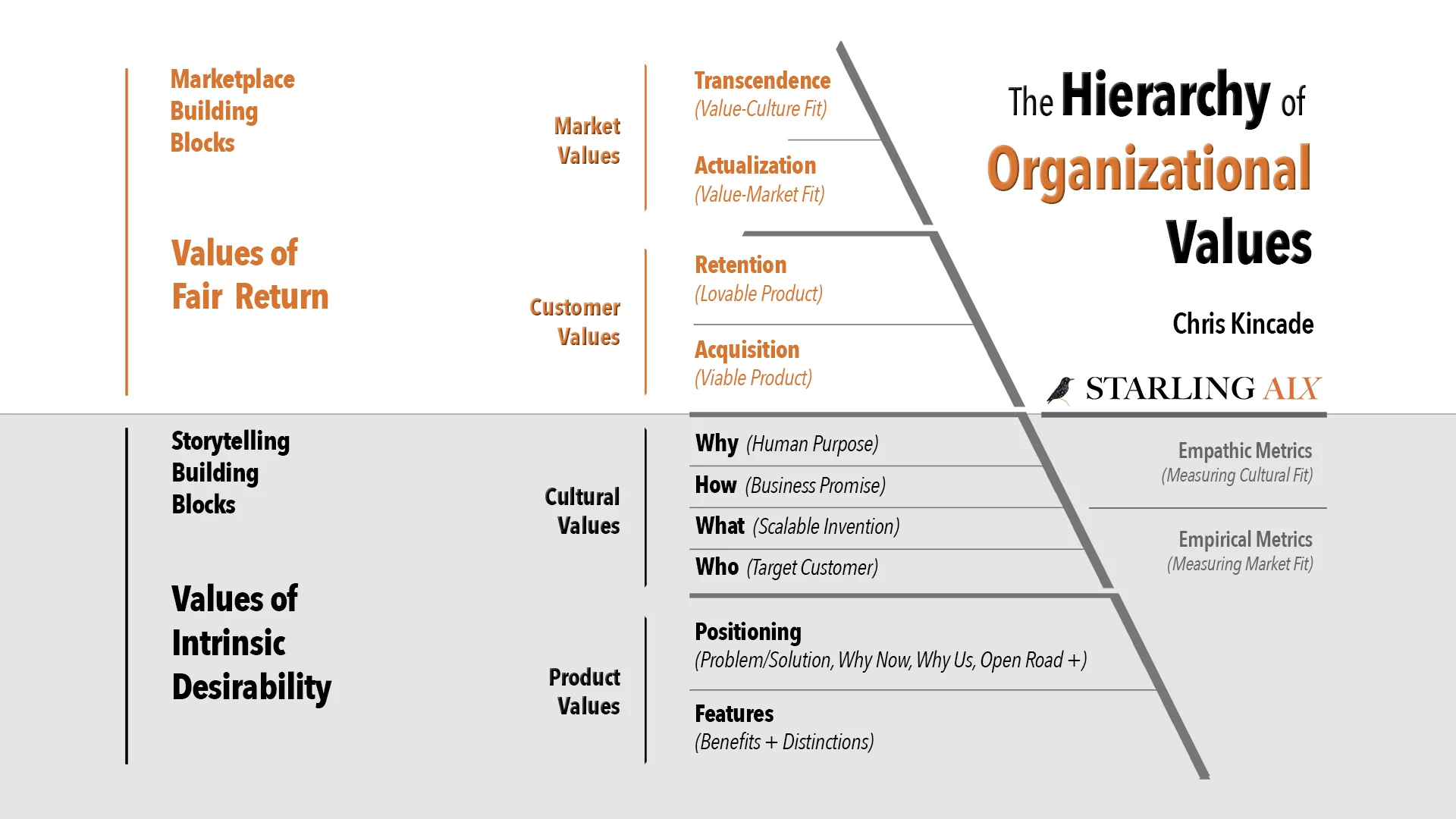
Like Maslow's hierarchy, the 17 Value Systems stack in a specific order.
In discovery, every conversation on values must Start with Why. However, in the Hierarchy of Organizational Values, it is simply the ranking value of intrinisic desirability, which must serve the values of fair return.
From the bottom up:
Tier 1: Product Values
The foundation. Without these, nothing else matters.
- Problem/Solution: What pain do you solve?
- Why Now: Why is this your moment?
- Why Us: Why are you the ones to solve it?
- Open Road: Where's the uncontested space?
- Brand Pillars: What do you stand for?
- Features: What do you deliver?
These are table stakes. Every pitch deck covers them. Every competitor has answers. Product Values get you in the game — they don't win it.
Tier 2: Cultural Values
The identity layer. What you believe before anyone's buying.
- Why: What is your human purpose?
- How: What's your business promise?
- What: What's your scalable invention?
- Who: Who's your ideal customer?
- UVP: What's your unique value proposition?
This is Sinek's domain — Start With Why — properly positioned in a larger architecture. Cultural Values are necessary but insufficient. Belief without market validation is just faith.
The Fulcrum: Dual Metrics
Sitting between the Storytelling and Marketplace Values, Dual Metrics provide the measurement layer that connects story to market.
- Empirical Metrics: Measuring performance, efficiency, output.
- Empathic Metrics: Measuring engagement, sentiment, loyalty.
Most businesses measure only Empirical. They know their conversion rate but not their trust score. Dual Metrics complete the picture.
Tier 3: Customer Values
The bridge between internal belief and external behavior.
- Acquisition Values: What attracts first-time buyers?
- Retention Values: Why do loyal customers return?
This is where values meet evidence. Customers vote with their wallets. They stay or they leave. Customer Values transform belief into proof.
Tier 4: Market Values
The apex. Where your values become culture.
- Market Actualization: Value-Market Fit
- Market Transcendence: Value-Culture Fit
Value-Market Fit is when the market validates your values — not just your product. Value-Culture Fit is when your values reshape the market itself. Patagonia telling customers not to buy their jacket. Apple making "Think Different" mean something. A local coffeeshop becoming a community fixture.
The Prime Directive
The operating logic of Value-Centric Design:
Hone the values of intrinsic desirability to unlock the values of fair return.
Product and Cultural Values, the bottom rungs, represent intrinsic desirability — what makes you compelling and distinctive. Customer and Market Values, the top tiers, represent fair return — what the market gives back when you deliver.
The hierarchy flows upward: Product → Cultural → Customer → Market. Internal values must transform into external validation.
But here's the key: WHY leads the pitch. Your human purpose is the emotional core of your story. Yet it ranks below Customer and Market Values in the hierarchy. Business doesn't end with a great pitch. You have to deliver fair return.
This is why the 17 Value Systems aren't a checklist — they're the semantic foundation that makes organizational intelligence possible. When you codify your values through these systems, you create the architecture that transforms a generic LLM into your Domain Language Model.
The values become addressable. The hierarchy becomes executable. The organization becomes speakable.
On Cognitive Design is a weekly newsletter on organizational intelligence and information sovereignty in the AI age.
Chris Kincade is the founder of Starling AIX and creator of Universal Cognitive Architecture.
Ready to build organizational intelligence? Download the free Universal Cognitive Architecture Standard — the foundational framework for making your business speakable to AI — and join the UCA Community.
© 2026 Starling AIX
Responses